
Director as Listener
what is the director's role in directing new play workshops?

Having in May produced, (and directed in) the inaugural Made In Cincy new play festival at Cincinnati Playhouse, I found myself thinking (again) about the particular job of directing a workshop. What is the role of the workshop director?
When I was a younger director, I often heard people talk about new play development in terms of “serving the playwright” or “giving the playwright what they want.” At the same time, I saw some of my peer directors treat workshops as potential big breaks, so they would focus on making their directing visible.
Neither approach ever sat quite right with me. The first seemed too obedient, as though the director had no artistic responsibility beyond being agreeable. The second seemed too hungry, as though the play were a platform for the director’s self-display. I was sure it was something in-between those things, but I often felt at sea about what I was supposed to be doing when I directed a new play.
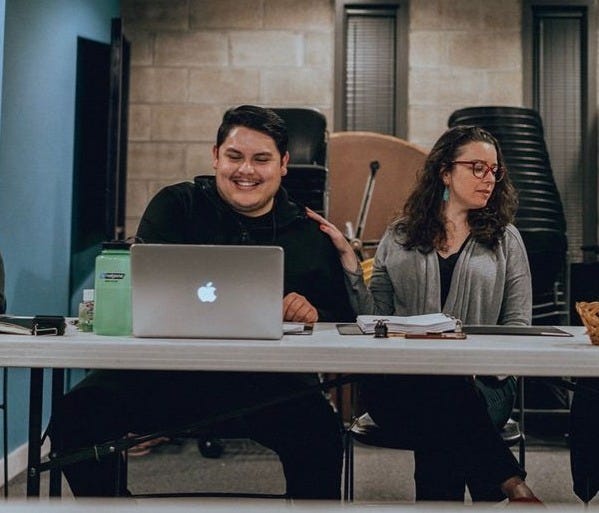
Part of the difficulty is that there are so many different kinds of workshops. There are workshops with a public reading at the end and workshops no one outside the room will ever see. Workshops with many hours and workshops with very few. Workshops where the writer has a precise question and workshops where the question is simply, “What did I write?” A first draft needs something different from a play nearing production. A farce needs something different from a grief ritual. A play made of language needs something different from a play made of plot.
This is why there isn’t a rule I can easily point to. The form has to be built in response to the play.
There is a great chapter in Mary B. Robinson’s book Directing Plays, Directing People where she discusses how her approach to new plays evolved. I particularly love the question she lands on as a guiding principle: “What does it want to become?” She differentiates this from her earlier, more result-oriented approach, when she was trying to “make it work” instead of listening to the play.
That question has stayed with me because it shifts the director’s posture. The task is not to force the play to behave. The task is to attend to the play’s truth.
I try to practice listening to the play.
I think of myself as being in service to the play, not the playwright. That distinction matters to me. To say I am in service to the play rather than the playwright is not to diminish the playwright’s authority. The play is theirs. But a play is not made only of conscious intention. It is also made of pattern, accident, pressure, contradiction, rhythm, obsession, and the mysterious material the writer may have smuggled in without knowing it. As a close reader of plays, I often see connections underneath the surface. Sometimes those connections are intentional. Sometimes they are part of the magical subconscious of creation. Part of my job is to notice those things and reflect them back: in how I talk with the writer, in the questions I ask, and in the way I pursue the work in rehearsal.
I ask questions to refine my understanding. I listen to what the writer says they want the play to be doing. And I also look closely at what the play itself seems to be doing. Then I try to build a process that helps everyone hear that more clearly.
That listening eventually has to become directing.
Casting is one of the first acts of translation. Working with the theater and the playwright, the director helps find the people whose instincts can reveal the play. Sometimes the right actor makes a hidden rhythm audible. Sometimes they make a character’s contradiction legible. Sometimes they show the writer something they did not know they had written. And sometimes, frankly, a miscast reading can also be educational. It can reveal what the play is not, which is not nothing.
Then comes rehearsal: asking questions, finding action with the actors, clarifying relationships, and locating the event of each scene. Even in a reading, even with scripts in hand, the actors need to know what is happening between people. They need to know what they want, what they risk, what changes, and why this scene has to happen now.
And then, if there is a final presentation, the director has to decide what that presentation should look like.
If there is an audience, the director has a responsibility to them too. Not to disguise the unfinishedness of the play, and not to smooth over every rough edge, but to make sure they are encountering the clearest possible version of the play in its current form. Their response is part of what the playwright gets to learn from. The audience is not there to admire the director’s solutions. They are there to receive the play.
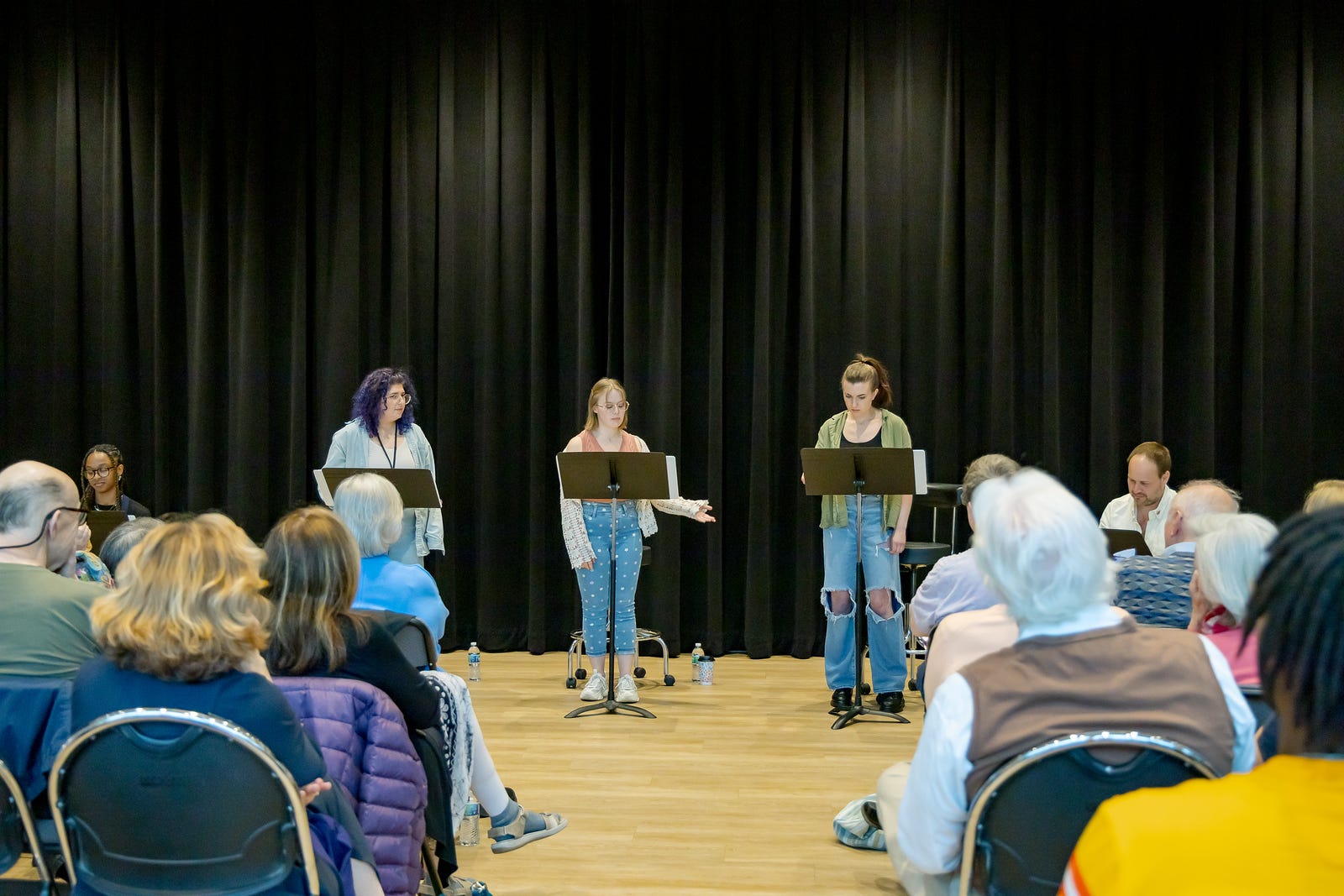
I tend toward the simplest approach. In most readings, I want the audience to hear the words and watch the actors act the beats, rather than watch actors manage elaborate staging with scripts in hand. More is not always clearer. Sometimes staging becomes noise. It can take away from the audience’s ability to imagine the eventual production, and instead watch the cleverness of the staging happening in front of them.
But the absence of staging can lie too. Some plays reveal themselves through bodies in space. Some plays need rhythm, proximity, timing, interruption, or physical consequence. Some moments need to be staged because otherwise the audience cannot understand the experience the play is trying to create. The question is not “How much staging can we manage?” The question is “What does the audience need in order to experience the play truthfully in this form?”
In Made In Cincy, Isaiah Reaves’s play The Mink was a farce, and the humor of the play could not be fully communicated by language alone. In farce, the joke often lives not only in the line but in the timing, the almost-missed exit, the pressure of people being in the wrong place at the wrong time. Director Steven Sapp included just enough physical comedy to give the audience the mechanism of the humor without overwhelming actors who had scripts in hand. The staging did not pretend to be a production. It simply helped the audience take the ride the play is becoming.
That balance is the answer I was looking for as a young director. Not a fixed rule, but a question with a different answer on every play: “What does this play need in this workshop?”
The best workshops happen when the alchemy is right between the director, the playwright, and the play. I do not claim to be the right director for every play. I do not always know what a particular play is reaching toward. Even when I listen well, I mishear things. I make choices that reveal something and choices that obscure something. All creative processes have moments of discord. I think that is part of it: the way we sometimes get lost in a new place in order to learn the map.
Peter Brook wrote, “Every choice I’ve ever made has been dictated by a formless hunch rather than by strict logic.”
That feels true to me. Directing a workshop requires rigor, craft, and preparation, but it also requires a willingness to follow the formless hunch. To listen beneath the obvious thing. To ask Mary B. Robinson’s question, “What does the play want to become?” before deciding what we want to make it do.
The director is not there to finish the play. The director is there to translate it as clearly and truthfully as possible, so the audience can have an honest experience of it and the playwright can hear what is working, what is asking for more, and what the play may want to write toward next.
The director is there to help the room hear the play clearly enough that the next question becomes possible, and the play can keep becoming.
EVERYTHING BUT REHEARSAL IS BACK!!
It will be two years since I last had time to teach this online workshop in director preperation, but I found a window and am excited to announce that Sunday nights, starting June 26, my six-week zoom class is BACK.
A substantial amount of a director’s work is done during the time before rehearsal begins, yet what a director does in this period can be mysterious because much of it is done alone. This online workshop is for directors to expand their toolbox of techniques and exercise their skills in director preparation. Each participant will bring a play to prepare for the six-week workshop. During weekly Zoom sessions, we will read about and try different preparation methods and practice moments with guest professionals such as pitching a play, first meeting with designers, and first rehearsal in a supportive setting to learn and develop skills.
Each participant will bring a play they are planning to direct, dreaming of directing, or using as a serious practice text for the six weeks. Together, we’ll explore different approaches to preparation, text analysis, research, images, pitching, designer conversations, casting, and first rehearsal presentations.
This is a small, intimate workshop with room for everyone to participate fully, ask questions, try things out, and receive feedback in a supportive environment.